A mature, fully delineated oil block in the Four Corners region — with proven conventional reserves and a deep unconventional resource still untouched.
Acres Leased
9322
BBL recoverable
41.79MM
PV10 @ $60/BBL
$525.3MM
Wells drilled
128
LOCATION
Where the field sits
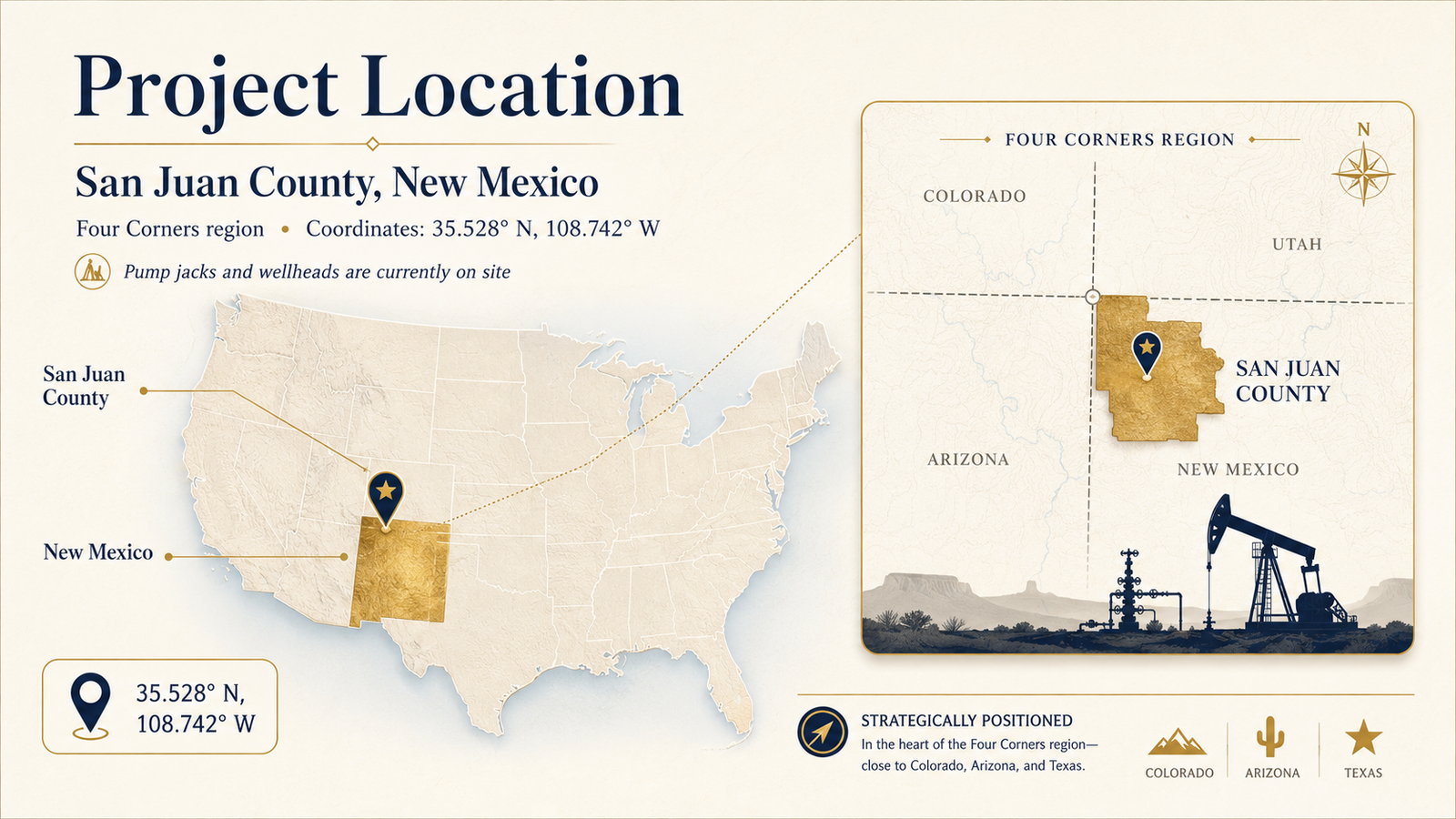
San Juan County, northwestern New Mexico, in the Four Corners region. The lease covers four blocks across two areas — Horseshoe and Many Rocks in the south, Mesa and Many Rocks North in the north.
35.528° N, 108.742° W
THE FOUR BLOCKS
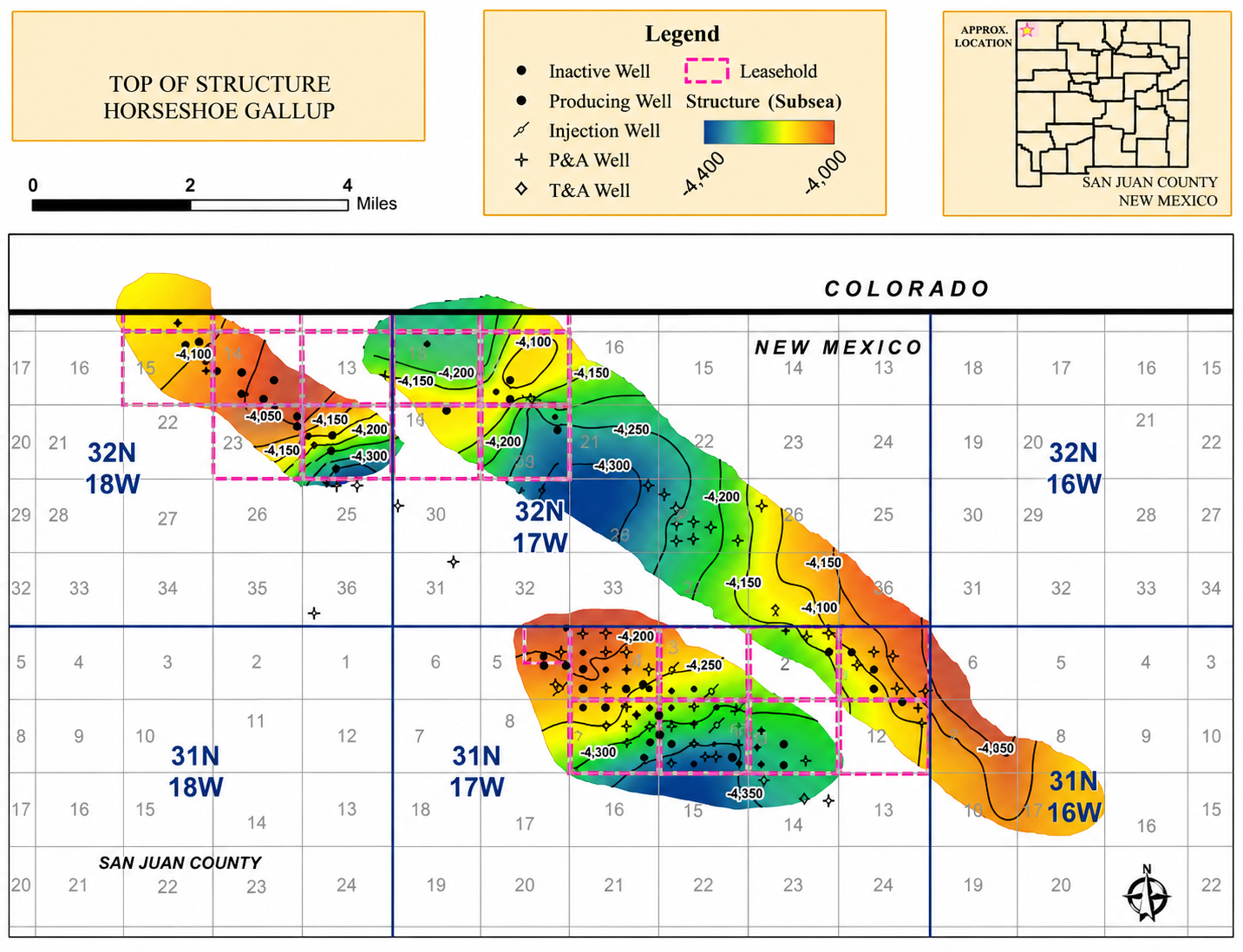
Horseshoe Gallup
2,567 acres · 860–1,150 ft
Geological 21.78 MMbbl
Many Rocks Gallup
1,139 acres · 1,190–1,658 ft
Geological 7.58 MMbbl
Mesa Gallup
1,231 acres · 1,163–1,762 ft
Geological 7.60 MMbbl
Many Rocks North
2,093 acres · 1,385–1,794 ft
Geological 15.62 MMbbl
Why this land is valuable
Think of it as a building with three floors
Most oil leases have one layer of oil. This one has three, stacked on top of each other underground — so the same piece of land can earn money three separate ways.
Top floor
Mancos Shale
A shallow layer near the surface. Not tapped yet — held in reserve.
300 – 800 ft down
Middle floor
earning now
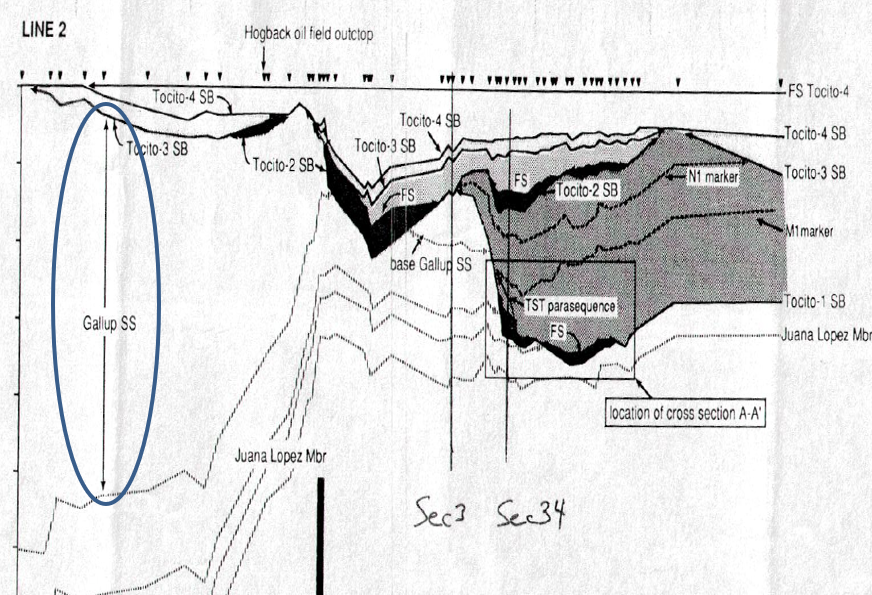
Gallup Formation
This is where the oil is being produced today. Light, high-quality crude that sells at a premium.
850 – 1,450 ft down
Bottom floor
the big one
Paradox Formation
The deepest and largest layer. Untouched so far — and it holds about three times the oil of the floor above.
~8,500 ft down
We're already earning from the middle floor, while the top and bottom floors are value we haven't even started on yet.
Is it real?
Yes — and here's how you can tell
This isn't a plan on paper. It's physical land with real equipment, a real address, and a 70-year track record you can look up.
You can find it on a map
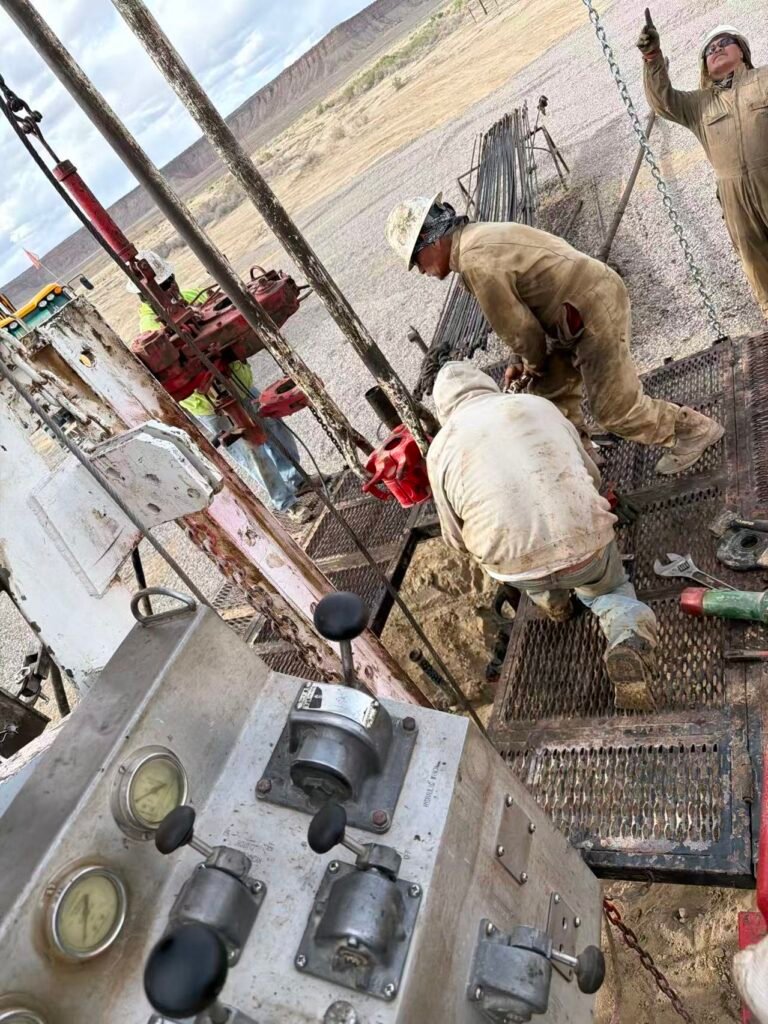
San Juan County, New Mexico. Coordinates 35.528° N, 108.742° W. Pump jacks and wellheads are on site right now.
128 wells already drilled
128 wells have already been drilled here. Every one of them logged what the rock holds, and 40 are active today.
It has produced since 1958
The field was discovered in 1958. Over 6 million barrels of oil have already come out of this ground and been sold.
Evaluated and documented
The reserves and PV10 valuation are set out in the Horseshoe Gallup Reserves Evaluation Report, issued by Y&B Investments LLC in February 2026, with its methods and assumptions stated in full.
Reservoir Characteristics
Stratum: Mainly Cretaceous Gallup formation, simple nose and anticline structures.
Crude Oil: API 36–42, classified as light crude oil.
Reservoir Depth: 860–1,794 ft, thickness 9–30 ft.
What's still in the ground
Enough oil left to matter
Since 1958, only a fraction of the oil has been taken out. Here is what the February 2026 reserves evaluation says is still recoverable — split between the floor we produce from now, and the deep floor we have not started.
Middle floor · producing now
10.4
million barrels
Still recoverable from the Gallup layer. This is the proven, lower-risk oil we produce from today.
Bottom floor · not yet started
31.4
million barrels
Estimated recoverable from the deep Paradox layer — the biggest opportunity, and the reason this lease is worth more than a typical field.
In oil terms: "recoverable reserves" means the oil that can realistically be brought to the surface and sold — not every drop underground, but the portion that pays.
What it's worth today
$525M
The present-day value of the oil this field is expected to produce — in today's dollars, after costs.
Middle floor (Gallup)
$174M
Bottom floor (Paradox)
$351M
Total value
$525M
The industry term for this is PV10 — the standard way U.S. oil companies report the present-day cash value of a field's future production, discounted at 10% per year. Calculated at $60 per barrel, after operating costs. Roughly $56,000 of value per acre of land.
How we develop it
Drilling Plan
Drill the proven layer
New horizontal wells in the Gallup layer we already produce from. We know the oil is there — this is about producing it faster.
Strategy
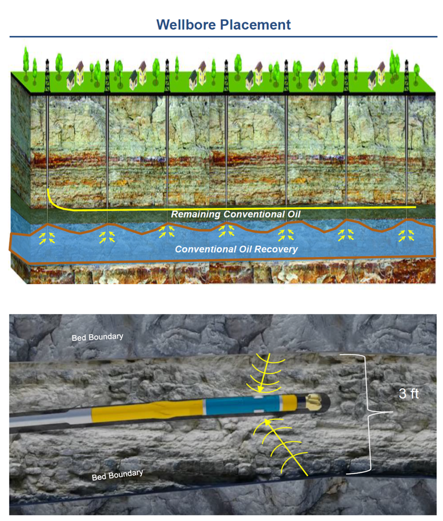
The oil layer here is thin, and large amounts of oil still sit untapped between the old wells. So we drill horizontally — down about 1,100 feet, then roughly 2,000 feet sideways through the layer, for a measured depth of over 3,000 feet. One well reaches far more oil than a vertical well ever could, including the oil the old wells missed.
Technology
Each well drills down to the oil layer, then curves and runs sideways through it, guided by live sensor data that keeps the bit inside the layer. These are proven, standard U.S. oilfield methods, applied to a shallow, well-understood formation.
Want to see the full picture?
We'll walk you through the complete reserve report, the numbers behind the valuation, and how this project fits an EB-5 investment.
The reserve estimates and valuations on this page are professional engineering projections based on stated assumptions, not guarantees of future production, revenue, or return. Actual results depend on oil and gas prices, market conditions, regulatory factors, and operational performance. PV10 is a standardized industry measure calculated before capital expenditure and is not a measure of fair market value. This page is for information only and is not an offer to sell or a solicitation to buy any security or investment.